
AI Hallucinations Explained: Why Artificial Intelligence Makes Mistakes
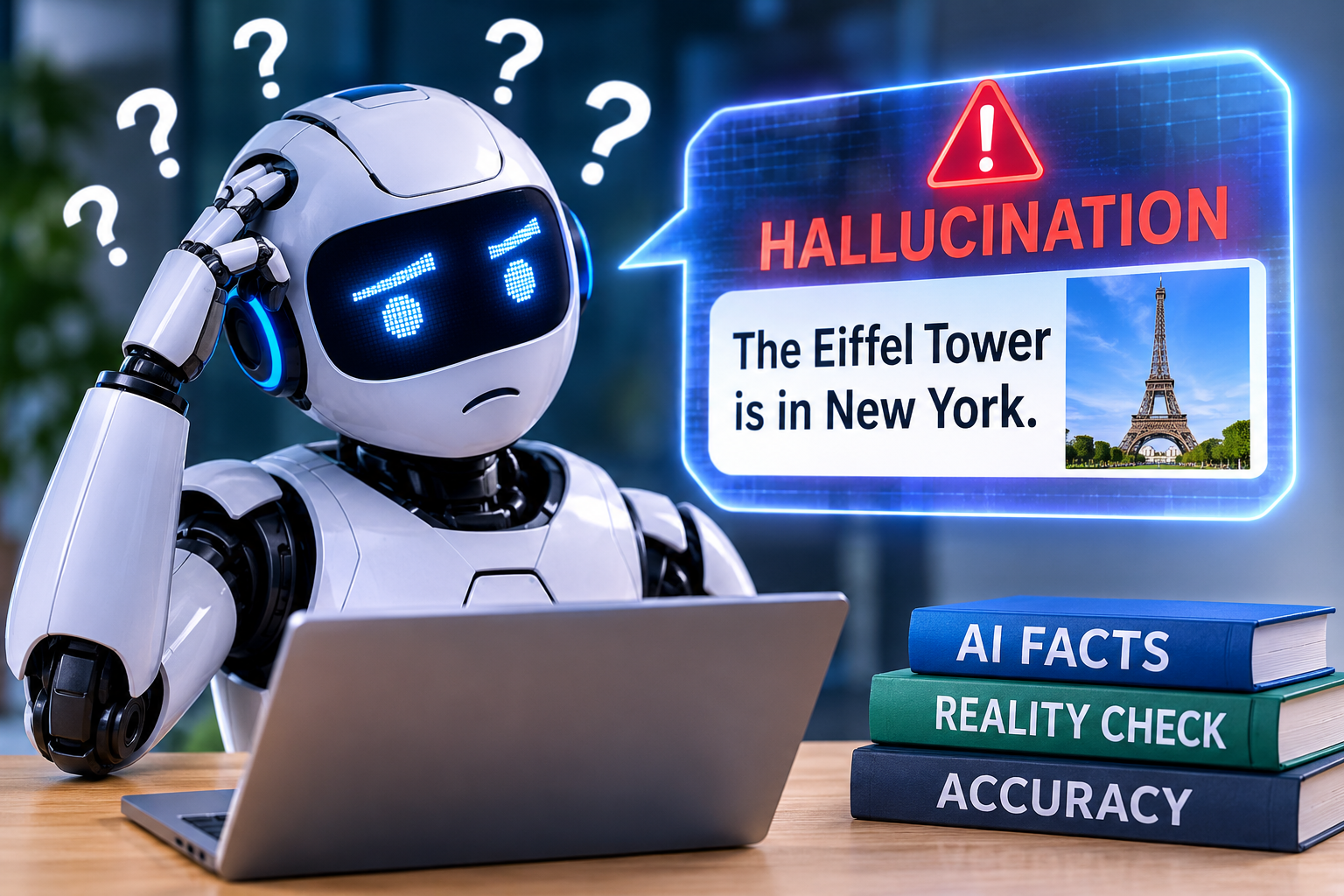
Artificial intelligence can write articles, answer questions, summarize documents, and analyze complex information in seconds. However, even advanced AI tools sometimes provide information that sounds convincing but is completely incorrect. This problem is known as an AI hallucination.
AI hallucinations occur when an artificial intelligence system generates false, misleading, unsupported, or fabricated information and presents it as a reasonable answer. These mistakes can include invented statistics, fake research papers, incorrect historical facts, nonexistent website links, and misleading explanations.
As businesses, students, healthcare professionals, and everyday users increasingly depend on AI tools, understanding why artificial intelligence makes mistakes has become important. Knowing how hallucinations happen can help people use AI more responsibly and recognize when an answer needs verification.
Key Takeaways
- AI hallucinations happen when artificial intelligence generates false or unsupported information.
- Large language models predict likely words and patterns rather than independently verifying every fact.
- Incomplete training data, ambiguous prompts, outdated information, and weak context can contribute to hallucinations.
- AI-generated legal references, statistics, medical information, and citations require verification.
- Better prompts, reliable sources, retrieval-augmented generation (RAG), and human review can reduce hallucinations.
- Even advanced AI models can make mistakes, so their answers should not automatically be treated as facts.
What Are AI Hallucinations?
AI hallucinations are incorrect or fabricated responses produced by artificial intelligence systems. They occur when an AI model generates information that appears logical but is not supported by reliable facts or available evidence.
The term is commonly associated with large language models (LLMs), including ChatGPT and other generative AI assistants. However, hallucinations can also occur in AI image generators, voice systems, and other machine learning applications.
For example, imagine asking an AI chatbot to identify a book written by a particular author. Instead of admitting that it cannot find the information, the chatbot might generate a convincing book title, publication date, and publisher that do not exist.
The response may look professional, but the information is fabricated.
According to the National Institute of Standards and Technology (NIST), this behavior is also described as confabulation. It includes confidently presenting false information or generating content that contradicts the provided context.
Why Does Artificial Intelligence Hallucinate?
AI hallucinations do not usually happen because a system intentionally tries to mislead someone. They are connected to how generative AI models learn, process information, and produce responses.
Here are the major reasons behind these errors.
1. Predicting Words Instead of Verifying Facts
Large language models generate responses by predicting which word or token is most likely to come next based on the preceding context.
They learn language patterns from enormous collections of text. However, predicting a convincing sentence is not the same as checking whether its claims are true.
This is one reason an AI chatbot can produce a fluent explanation containing incorrect information.
OpenAI's 2025 research explains that conventional training and evaluation methods can reward models for guessing rather than acknowledging uncertainty.
2. Incomplete or Inaccurate Training Data
AI models depend heavily on the quality of their training information.
If their training datasets contain outdated information, factual errors, biased material, or incomplete coverage of a subject, the model may learn incorrect associations.
This problem becomes particularly noticeable when users ask questions about lesser-known individuals, specialized industries, or subjects with limited reliable information.
3. Ambiguous or Poorly Written Prompts
The way someone asks a question can also influence AI accuracy.
For example, asking "Tell me about John's latest research" without identifying John or specifying the research topic leaves important details unclear.
The AI may make assumptions and generate information that does not match the user's intention.
Providing clear instructions, relevant background, and specific questions can reduce this risk.
4. Outdated or Missing Information
Some AI models have limited access to current information. Their original training data may not include recent events, updated regulations, new research, or changes in company policies.
Without access to reliable external information, a model might provide an outdated answer or invent details to fill information gaps.
5. Evaluation Systems That Reward Guessing
Another important factor is how AI systems are evaluated.
If a model receives better scores for providing an answer than for admitting uncertainty, it may develop a tendency to guess when information is missing.
OpenAI researchers have discussed this issue in their September 2025 paper, Why Language Models Hallucinate. The research highlights how training and evaluation incentives can contribute to confident but incorrect answers.
Common Examples of AI Hallucinations
AI hallucinations can appear in different forms. Some are easy to identify, while others require careful fact-checking.
| Type of AI Hallucination | Example |
|---|---|
| Fake Citations | Inventing academic papers, research studies, or references that do not exist. |
| Incorrect Facts | Providing the wrong date of a historical event or an inaccurate factual statement. |
| Fabricated Statistics | Presenting unsupported numbers or invented figures as official data. |
| Fake Legal Information | Creating nonexistent court cases, legal precedents, or judicial decisions. |
| False Biographies | Inventing someone's educational qualifications, career history, or family details. |
| Misleading Summaries | Adding claims or details that were never included in the original document. |
One well-known example involved a U.S. lawyer who used ChatGPT to prepare legal documents in 2023. The chatbot generated fictitious court cases and legal citations that were included in a court filing.
The incident demonstrated why AI-generated legal information must be checked against actual court records and authoritative legal sources.
Also Read: Joe Atkinson: Biography, Career, Education, Family and PwC AI Leadership
How Can AI Hallucinations Affect People and Businesses?
AI-generated misinformation can create problems when users treat an automated response as verified information.
The risks depend on where and how the technology is used.
- Healthcare: Incorrect medical explanations may confuse patients or influence decisions about treatment.
- Education: Students may unknowingly include fabricated references or incorrect facts in assignments.
- Business: Companies may make poor decisions based on inaccurate market research or financial information.
- Journalism: Publishing unverified AI-generated claims can spread misinformation and damage editorial credibility.
- Legal services: Invented laws, court decisions, and legal references can create serious professional consequences. The U.S. Department of Energy also identifies reliability, validation, and human oversight as important considerations when using generative AI.
How Can AI Hallucinations Be Reduced?
AI hallucinations cannot be completely eliminated, but users and developers can take practical steps to reduce them.
1. Use Reliable Sources
AI systems should be connected to trusted information, including government websites, academic publications, official records, and verified databases.
2. Use Retrieval-Augmented Generation (RAG)
Retrieval-augmented generation allows an AI model to retrieve relevant information from external databases or documents before generating an answer.
This approach provides additional context and helps connect responses to verifiable information.
However, RAG is not a perfect solution. Incorrect search results or poorly retrieved documents can still produce misleading answers.
3. Write Clear Prompts
Users should provide specific instructions and relevant context.
For example, instead of asking an AI tool to explain a recent government policy, specify the policy name, country, date, and requirement to use official government sources.
4. Encourage Uncertainty
AI systems should be instructed to acknowledge when information is unavailable.
A useful instruction is: "If the available evidence does not support an answer, say you do not know instead of making assumptions."
5. Verify Important Information
Human review remains essential, particularly for medical, financial, legal, and journalistic content.
Check names, dates, statistics, quotations, citations, and source links before relying on an AI-generated response.
Can AI Hallucinations Be Completely Eliminated?
No. AI hallucinations remain a technical challenge, even as generative AI systems become more advanced.
Developers are improving model training, data quality, evaluation methods, grounding techniques, and fact-checking capabilities. However, these improvements do not guarantee that every generated answer will be correct.
The Google Cloud explanation of AI hallucinations also highlights the importance of training data quality and grounding information in reducing inaccurate outputs.
The most practical approach is to treat AI as an assistant rather than an unquestionable source of truth. Its ability to generate information quickly is valuable, but important claims still require independent verification.
Frequently Asked Questions (FAQs)
1. What is an example of an AI hallucination?
An example is when ChatGPT invents a scientific study, provides a fake website link, or creates a court case that does not exist. The response may sound convincing but contains fabricated information.
2. Why does ChatGPT sometimes give wrong answers?
ChatGPT can give incorrect answers because it predicts likely text patterns rather than independently verifying every statement. Incomplete context, ambiguous questions, outdated information, and limitations in training can also contribute to mistakes.
3. Are AI hallucinations dangerous?
Yes, depending on the situation. Incorrect AI-generated information can create risks in healthcare, finance, education, journalism, and legal services, especially when users rely on it without verification.
4. Which AI models can experience hallucinations?
Large language models and other generative AI systems can experience hallucinations. This includes ChatGPT, Google Gemini, Microsoft Copilot, and other AI assistants. The frequency and types of errors vary between models and tasks.
5. How can users identify AI hallucinations?
Users can check important claims against authoritative sources, verify references and website links, compare information from multiple reliable sources, and look for unsupported statistics or suspiciously specific details.
About the author
- The Manhattan Weekly is a modern digital publication covering the stories shaping business, culture, technology, entertainment, lifestyle, and society. Inspired by the energy and innovation of Manhattan, we deliver insightful journalism that connects local perspectives with global conversations.
Comments
Join the discussionNo comments yet. Be the first to comment.